 CO2 is a potent greenhouse gas and our forests are one of our biggest weapons to mitigate against climate change by sequestering CO2.
In the US researchers have been trying to measure just how much carbon the forests capture. Listen to this podcast from Science Friday with host John Dankosky talking to research fellow at the World Wildlife Fund Christa Andersen and research project leader Christopher Woodall with the USDA Forest Service.

Currently in the US 15% of CO2 is being sequestered into the forests (see the USDA Forest Service analysis). Currently there is masses of carbon that is being held in US forests; some forests providing long term storage for up to a millennia. Droughts in the west of the United States reduces the amount of carbon sequestration whereas the forests of the east are being rejuvenated and are fairing much better.
In California forest owners have been offered to join carbon offset programmes where with appropriate management (ie harvesting trees every 40 years instead of every 20 years) they can be offered carbon credits that can be sold to the great carbon gas emitters like power plants. A word of warning though; Christa Anderson sees that sequestering carbon is a way forward but we must also reduce our energy and carbon emissions. Forest carbon sequestering is not a magic bullet.
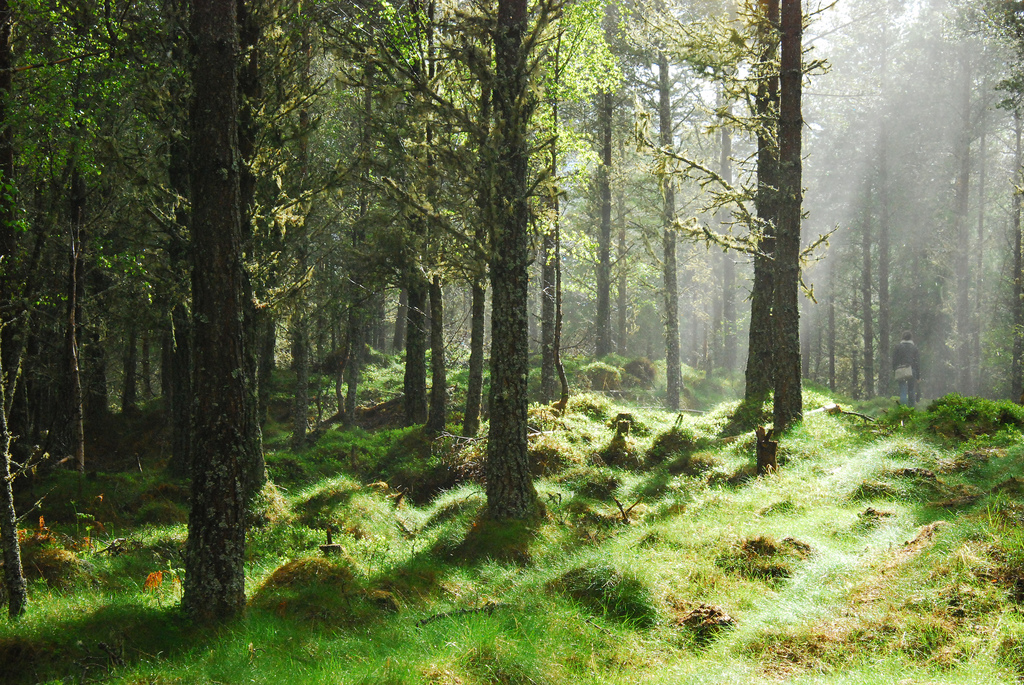
When we look at UK woodlands as a whole, the Forestry Commission cites an average of around 5.4 tonnes of carbon dioxide per hectare per year being sequestered (from Planting More Trees).
The Forestry Commission alone own 0.86 million (840000) hectares as of 2018 which means in a crude calculation that 4,536,000 tonnes of CO2 are being sequestered yearly. To put that in perspective in 2017 the UK produced 388 million tonnes of CO2.
The Independent’s article on trying to meet climate targets highlights the enormity of the task:
To get to net zero we need to find methods to take 130 million tons of carbon dioxide actively out of the atmosphere every single year.
They estimate that using methods already available such as planting trees and restoring natural habitats it should be possible to remove 35 million tons of CO2 by 2050. This includes expanding the UK’s existing forested area by 1.2 million hectares, around the size of Yorkshire.
Professor Nilay Shah from Imperial College London (from the Independent)
We desperately need to reduce carbon emissions now, plant trees and invest in renewables and other viable carbon sequestering schemes.
 Taunton Transition Town