David Blake – Thoughts on impacts of J25/A358 improvements on otters
The civil engineering works conducted for improvements to J25/A358 has likely had negative impacts on local otter populations, both temporary during construction and perhaps in the longer term. Otters are present in the River Tone and its tributaries and are known to travel along streams such as the Broughton Brook and Black Brook which meet next to the M5 and then flow down to the River Tone right under the new road development at J25. I personally have seen an otter feeding on sticklebacks in a tiny culvert stream in lower Henlade, another small tributary stream that flows down to J25. Thus, it should be beholden on the road developers not to disturb, harm or otherwise block the movements of this protected mammal species. Hence, I was surprised to find in May 2020 a wire mesh screen with surrounding wooden boards blocking the Henlade stream that in the face of it, would block otters moving along the stream channel.
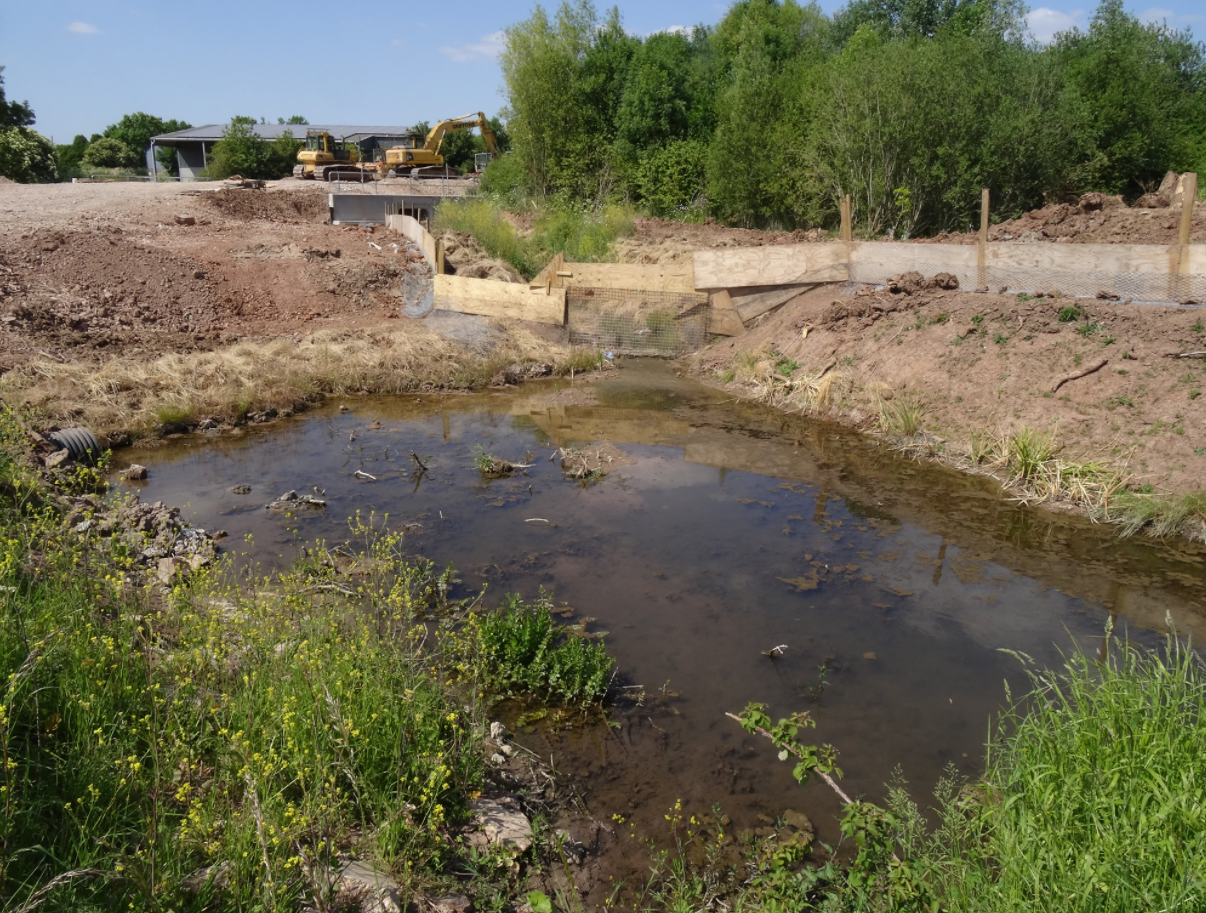
This raised some interesting questions about the extent to which otters had been considered in the Environmental Impact Assessment and project construction plans. A few enquiries to the Somerset Otter Group and some background checks on wildlife impact mitigations for this project revealed that otters were not comprehensively considered prior to construction going ahead. In the EIA the presence of otters was noted and ledges have been added to the bridges to help otters move under the roads in future. The wire mesh grill observed was apparently added to temporarily exclude water voles from the construction site, but did not consider the behaviour and needs of otters using the streams, which might have been put in danger of crossing busy roads as a result of these blocking structures. Indeed, the conservation and needs of water voles was apparently given higher priority than otters in and around the construction site (https://www.bbc.co.uk/sounds/play/p08q6p59), which oddly appeared overlooked as a species, during the construction phase at least. This may have been the result of an oversight during the wildlife survey, but I note that otters are similarly not mentioned specifically in the nearby and forthcoming Nexus 25 development documents (https://www.somersetwestandtaunton.gov.uk/…/environment…).
Otters which have been making a gradual recovery across Somerset over the last three decades or so need all the help they can get and poorly conceived or implemented infrastructure developments should be re-thought, before local populations of these iconic creatures are harmed. David JH Blake
 Taunton Transition Town