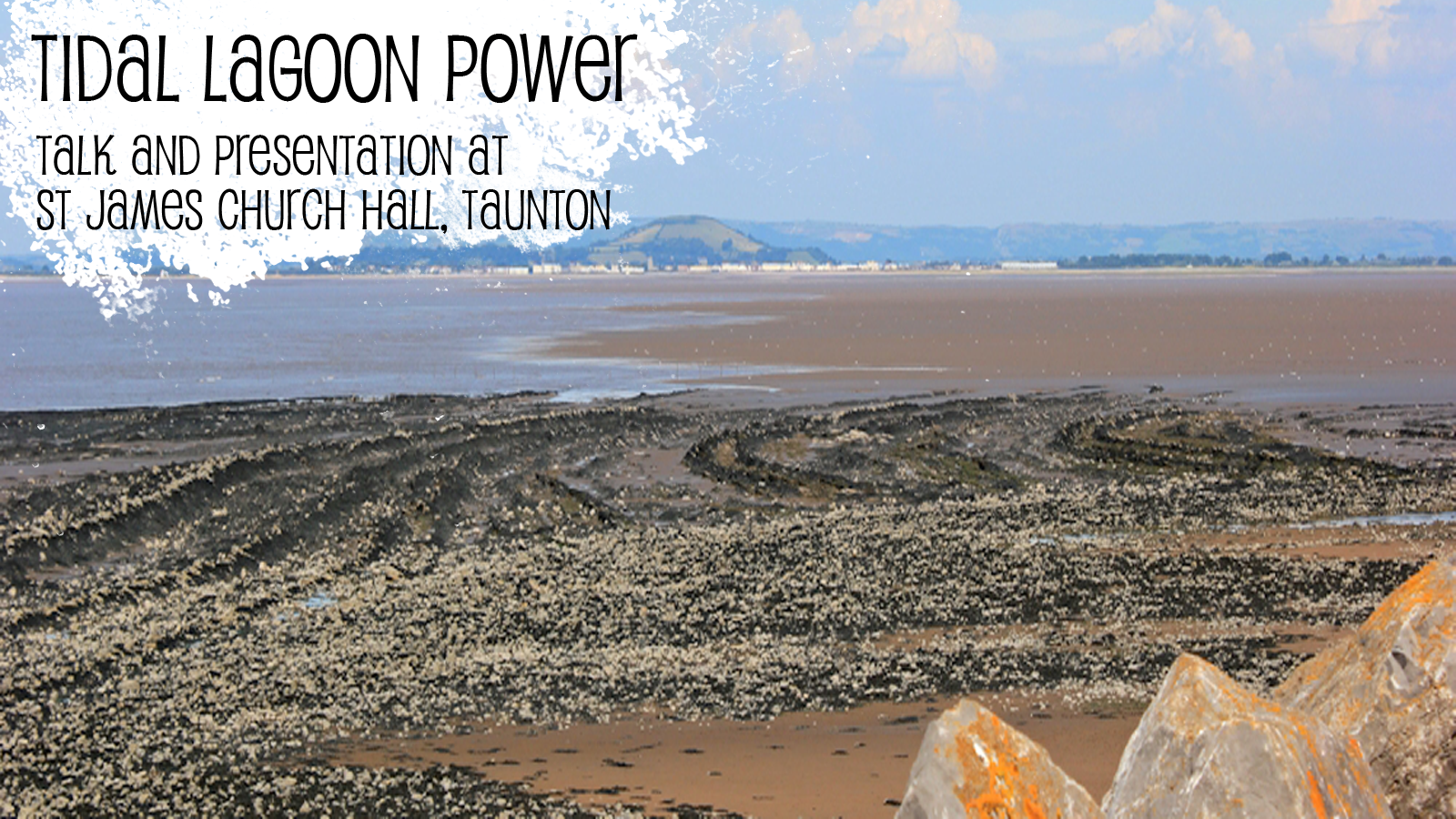
Want to find out about tidal lagoon power? Swansea is well on the way to have the first man made tidal lagoon system in the world with the ability to produce clean, renewable and predictable power for over 155,000 homes. The company Tidal Lagoon Power are seeing Swansea lagoon as being the blueprint for larger schemes up and down the Severn Estuary and in Cumbria. One of the potential locations is in Bridgwater Bay.
Find out more about tidal lagoon power and the potential in the local area from Steve Mewes of Tidal Lagoon Power (http://www.tidallagoonpower.com/). There will be a short presentation and time for questions.

Venue: St James Church Hall, St James St, Taunton
Date: 21st April
Time: 7.45pm for a 8.00pm start
Suggestion donation of £2.00 for presentation to cover costs.
Refreshments available for a donation
 Taunton Transition Town
Promising news. I read something on India trying to harness this green power but don’t know if anything came of it.
A conceptual plan has been approved for a tidal lagoon in Swansea Bay.Definitive approval will depend upon raising a subsidy four times that of that normally available for non-CO2 -emitting power stations Bearing in mind experience with Hinkley “C” (double the maximum subsidy) this will clearly be a challenge.
The promoters, Tidal Lagoon Power,also seem keen to take advantage of the high rise & fall in the Severn Estuary & are pursuing lagoon prospects between Cardiff & Newport on the Welsh coast & in Bridgwater Bay on the English side.These are preposterous,wildly impractical ideas.The simplest pilot scale studies would reveal this.
The Severn has experienced a well-established sequence of failures by the civil engineering industry going back 170 years in respect of lack of adequate attention to the threat of fine sediment incursion (coast-attached bathing water ponds,power-station cooling water ponds & the so-called “stilling ” pond at Royal Portbury Dock aimed at reducing silt incursion to the dock.An attempted tidal lagoon in the Severn,at either of the above sites is merely the worst of these failed structures.
The overwhelming problem is the exceptionally high & dynamic nature of the fine cohesive sediment load.On Springs between Watchet & the Second Severn Crossing more than 30 million tonnes are suspended & being conveyed up & down the estuary.On Neaps only 14 days later, only 2 million tonnes remains suspended,the extra 28+million tonnes has meanwhile settled onto the bed as dense fluid mud pools.This is an “awfully large quantity” to be on the loose,”looking for a home” in just a few days.Any part or wholly-built “silt-trap” in the form of a tidal lagoon would grab this & hold onto it.
The mean annual dredging need of all Severn Estuary ports lies close to 7-8 million tonnes/year.but docks have only a tiny ship lock to the sea & are only open for a few hours across HW when solids levels are relatively modest. In contrast a tidal lagoon would need many wide-open sluices & turbine bays to admit what is called the “tidal-filling” volume over a period stretching across much of the flood tide. It is essential not to “throttle” the inflow in order to admit this huge volume of water. (otherwise water levels inside & out don’t coincide!) With the incoming flood tide comes a similarly huge quantity of mud.A prolonged “still-stand” across HW itself waiting for a hydraulic head difference (perhaps 2m) to develop would permit much of this mud to settle in the lagoon.The siltation rate would be much greater than that which can be economically coped with by dredging.
Other perspectives are that the sub-tidal Bridgwater Bay mud patch contains not less than 600 million tonnes of soft settled mud.This would be a weak foundation material,as well as being acutely erosion-sensitive.Similarly the foreshores of the estuary are the greatest fine sediment source to the system running at 3-4 million tonnes /year. (so this is the fresh annual input)
A quite separate, but related, issue is that Severn muds seem enriched in the magnetic mineral,magnetite.Early impeller current meters used a magnetic reed switch to count rotations,which were converted into speed. These switches collected & seized solid with a grey magnetite flour after only 35-45 minutes of operation. Tidal turbines (for power generation) tend to need electro-magnets.There is no experience anywhere in the world of using a tidal turbine in a magnetite-rich flow field.If it were to be tried, would it segregate & seize the turbine?,impair its efficiency? or even get into the bearings?
Until Tidal Lagoon Power assure us these problems can be overcome (clearly they can’t) these concepts remain fanciful in the extreme.In fact just another of the many crackpot schemes.
Kirby R 1986 Suspended fine cohesive sediment in the Severn Estuary & Inner Bristol Channel,UK Report for Severn Tidal Power Group 243 pages
Roy… thank you for your knowledgeable input. This is the reason we are having the talk from tidal lagon power; so we can understand all aspects of any proposed schemes. I hope you can come along to ask pertinent questions. If not I will raise your queries with the company myself.
So many hurdles to overcome