A few days ago Amsterdam announced that it would adopt the first ‘city doughnut’ model [3] for circular economy; an adapted model from Kate Raworth’s doughnut economic model [1]. Check out this great video from the Auckland Writers Festival from 2019 where Raworth explains the need for a new economic model.
So rather than focus on GDP and growth (what Kate Raworth calls old 20th century economic thinking) the city of Amsterdam will focus on a completely circular economy, based on re-using raw materials to avoid waste and reduce CO2 emissions.
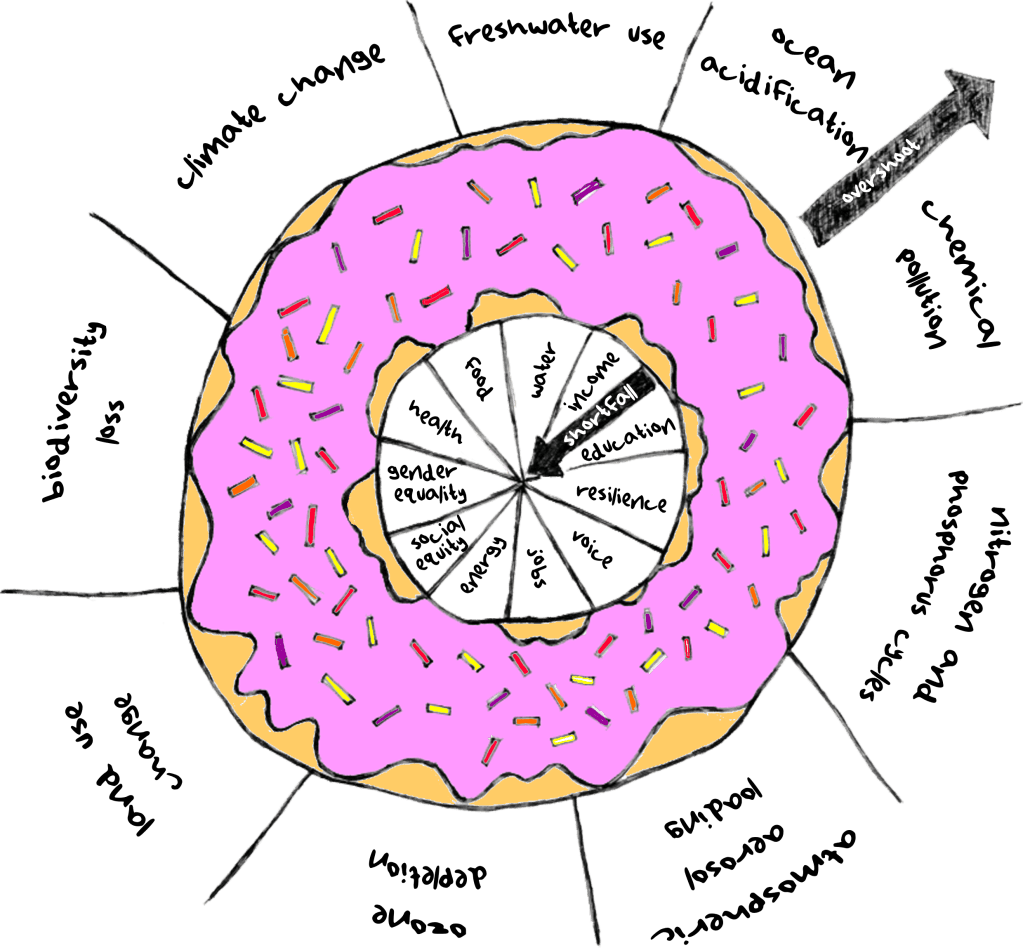
As you can see from the above diagram the idea is to get everyone in the doughnut and not fall into the inner circle or hole; the potential shortfall areas are based on the UN’s sustainable development goals. To reach these goals we have to ensure that we do not pressure our environment; shown by the outer circle and indicating the ceiling. This covers areas like biodiversity loss and climate change, pollution and land use change.
The doughnut does not bring us the answers but a way of looking at it, so that we don’t keep on going on in the same structures as we used to.
Amsterdam’s deputy mayor, Marieke van Doorninck from [2]
It is heartening that a city such as Amsterdam is looking to change the way that they ‘do business’ and depart from the the old economics of growth and supply and demand. Looking at the website for the ‘City Donut’ project [4] you can see that Amsterdam are building on what has previously been on the margins and not traditionally in the forefront of the city’s council and leaders minds; looking at food waste and the built environment (the city plan to regulate the building industry to use as much recycled and biobased products). They are taking issues like the lack of affordable housing (falling into the hole of the doughnut) and looking at ways to provide housing that does not overshoot and produce more CO2/pollution etc.
Hopefully Amsterdam’s bold move will lead to a city that manages to keep it’s citizens in the doughnut; something that other cities and indeed nations are failing miserably at. We need to think in different ways; in ways that understand the pressures that we humans are inflicting on the environment but still not providing for our basic needs. Perhaps Amsterdam is leading the way?
References
- Kate Raworth website – https://www.kateraworth.com/
- The Guardian – https://www.theguardian.com/world/2020/apr/08/amsterdam-doughnut-model-mend-post-coronavirus-economy
- Smartcitiesworld.net – https://www.smartcitiesworld.net/news/news/amsterdam-adopts-first-city-doughnut-model-for-circular-economy-5198
- Amsterdam’s Donut Coalition website – https://amsterdamdonutcoalitie.nl/
 Taunton Transition Town
[…] curator, and storyteller who campaigns with low income communities for a Universal Basic Income, Kate Raworth is the creator of the concept of Doughnut Economics, and Carne Ross is the author of ‘The […]